Textured Panel Surfaces for Safer Site Walking Routes
A walkway on a construction site is a specification, not an afterthought. The published grip-surface range runs from 9 mm to 21 mm thickness, with a textured hexagonal phenolic film, a standard 1220 × 2440 mm format and custom sizes up to 1830 × 3830 mm — and the same panels can be ordered for shuttering, so the route and the pour stop competing for different stock.

Key takeaways
- Textured hexagonal phenolic film is published on panels from 9 mm to 21 mm thick for different load requirements.
- Grip faces come single-sided with a smooth reverse, or double-sided where both faces are walked on.
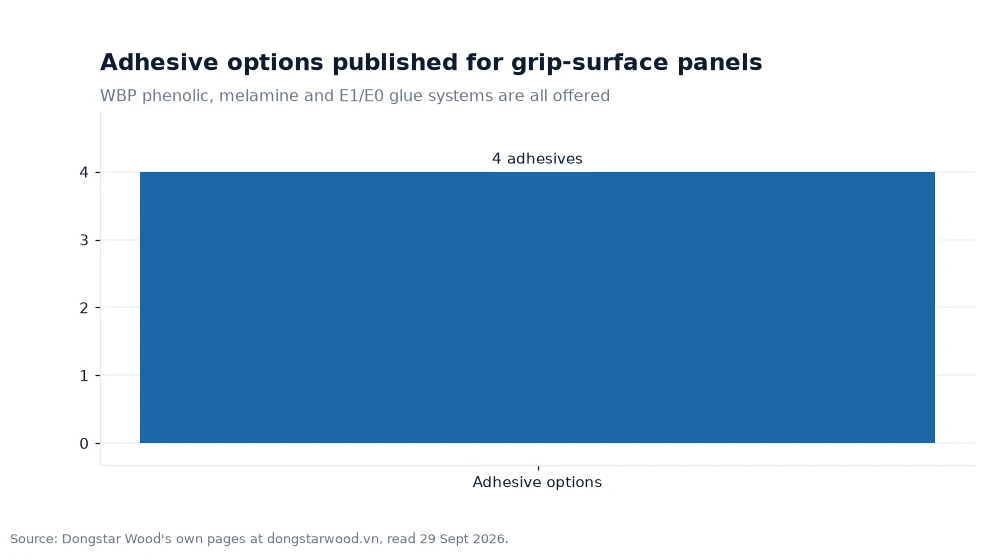
- Adhesive options published are WBP phenolic, melamine, and E1/E0 glue systems.
- A 120 m route at 1.2 m wide is 144 m², which is 49 sheets in 1220 × 2440 mm or 32 sheets in 1500 × 3000 mm.
Where a walking route turns into a specification
Temporary routes on a site are treated as consumables, and that is exactly why they cause injuries and delays. A smooth plywood deck that has been rained on is a hazard, and one that has been walked across with concrete dust on it is worse. Specifying a textured face turns the route into a product with a published surface, a thickness band and a known edge detail, which is a cheaper conversation than the one that follows an incident.
The published applications for this panel family are wide: concrete formwork and heavy-duty formwork, anti-slip formwork panels, high-rise shuttering, slip-resistant scaffolding boards, roofing walkboards, temporary flooring, safe access platforms, bridge deck construction and industrial concrete slab formwork. Read that list as one product doing two jobs — carrying concrete and carrying people — often on the same project and frequently on the same panel.
The hexagonal face, and why texture is the point
The surface is a textured hexagonal wire-mesh pattern pressed into a phenolic film, and the pattern is what separates this range from ordinary filmed panels. The client's own pages list it as Wire Mesh Film Faced Plywood and, in the same breath, as Anti-slip Film Faced plywood — two names for the same purpose: grip underfoot that survives being rained on and cleaned.
Beyond grip, the published claims are practical ones: a wear-resistant non-slip surface, moisture and wear resistance, protection against alkaline concrete exposure, and multiple reuse cycles where edges and surfaces are maintained. Sealed edges appear in the same description, which matters more than it sounds — an open edge is where a panel fails on a wet site, whatever its face looks like.
| Position on site | What the panel has to do | Published option |
|---|---|---|
| High-rise shuttering | Grip on the working face, straight concrete behind it | Textured hexagonal film with WBP phenolic glue |
| Scaffold and roofing walkboards | Non-slip underfoot on one face only | Single-sided textured film with a smooth reverse |
| Temporary flooring and access platforms | Two working faces, both walked on | Double-sided textured film |
| Concrete contact work | Film that resists alkaline concrete | Phenolic film surface with sealed edges |
| Bridge decks and industrial slabs | Repeated pours with maintenance between them | Thickness range of 9 mm to 21 mm |
Single-sided or double-sided grip
The choice is decided by which faces a person or a load will touch. A roofing walkboard is walked on one side and rests on a frame on the other, so a single-sided panel with a smooth reverse is the sensible order. Temporary flooring in a working zone is often lifted, turned and reused, and there a double-sided textured panel removes the risk of a smooth face coming up on top.
Shuttering adds a third consideration: the face that touches concrete has to leave an acceptable finish. Panels carrying grip surface on the contact face will imprint the texture on the concrete, so high-rise shuttering specifications usually pair a textured face for access with a separate smooth-faced set for the pour itself. Ordering both from one supplier keeps the thickness and edge detail consistent across the two.
Worked example: 120 metres of temporary walkway
A route 120 m long and 1.2 m wide covers 120 × 1.2 = 144 m². In the standard 1220 × 2440 mm format each sheet gives 1.22 × 2.44 = 2.98 m², so the route needs 144 ÷ 2.98 = 48.3, rounded up to 49 sheets. Switch to 1500 × 3000 mm panels and each sheet covers 1.5 × 3 = 4.5 m², which brings the count down to 144 ÷ 4.5 = 32 sheets exactly.
A middle option sits between them: 1250 × 2500 mm gives 1.25 × 2.5 = 3.125 m² per sheet, so the same route takes 144 ÷ 3.125 = 46.08, call it 47 sheets. The spread between 32 and 49 panels is the whole reason to fix the route width before ordering — a wider sheet yields fewer joints, fewer cut edges and fewer places for water to get into the core.
Edges, cleaning and reuse on a live site
Grip surfaces lose their value long before the panel is worn out, and the loss starts at the edge. An unsealed edge takes water into the core, the face lifts, and the texture that was doing the work disappears with it. Sealed edges and a waterproofing detail around cut openings are what the published description points at when it talks about reuse with proper edge and surface maintenance.
Cleaning matters for the same reason the texture exists. Mud and cured concrete sitting in the hexagonal pattern turn a non-slip surface into an uneven one, and the aggressive tools used to remove them take the film with it. Water, a stiff brush and a stack with stickers between panels is the routine that keeps a route in service across several phases of a build.
Label the panels by position as well. A route that is rebuilt three times on the same site goes together faster when each panel carries its phase number, and the labels also show which sheets have taken the worst of the weather, so the worst of them can be retired to the compound rather than to a working edge. Sealed edges plus a written rotation across phases stretches a set further than ordering replacements halfway through a job.
Frequently asked questions
Should walkboards be ordered single-sided or double-sided?
Single-sided textured panels with a smooth reverse suit boards that are fixed down on one face, such as roofing walkboards and scaffold planks. Double-sided textured panels suit temporary flooring and platforms that get lifted and turned, because both faces have to be safe whichever way the panel comes up.
Can grip-surface panels be used as formwork faces?
They can be used for formwork, and the range is published for concrete formwork and heavy-duty formwork as well as access work. The texture prints into the concrete, though, so where a fair-faced finish is required the usual arrangement is a textured panel set for access routes and a smooth filmed set for the concrete contact face.
Which adhesive systems are available for exterior-grade grip panels?
Four options are published: WBP (phenolic), melamine, and E1/E0 glue systems. Where panels meet rain, concrete and repeated cleaning, the WBP phenolic end of that list is the one usually specified, because moisture resistance and wear resistance are the two properties the application depends on.
Two pages to read alongside this one
If the same project pours concrete, the filmed shuttering range covers the smooth contact faces, film weights and thickness guidance for pours. And where the budget has to go furthest, the economical black film panel describes the melamine-bonded option quoted at roughly 3–5 reuse cycles.
All specifications above were read on the supplier's own site, viewed on 29 Sept 2026 as quoted in these notes as quoted in these notes and carried into this guide[1].