Prebuilt Cabinets and Remodel Timelines
The cabinet order is the longest lead item most homeowners control, and it is usually placed too late. CasaBuilt publishes 3-10 business days for flat-packed orders, within two weeks for pre-assembled orders and three business days or less for trade quick ship. Those windows are measured from order to dispatch, which means the date on the calendar belongs to the order, not to the installation.
Key takeaways
- RTA orders ship in 3-10 business days; pre-assembled orders are quoted at within two weeks.
- Trade quick ship promises three business days or less, and trade design takes less than 72 hours.
- For an install on day 30, a pre-assembled order should be placed by day 16 at the latest.
- Assembly time for flat-packed cabinets sits after the published window and inside your schedule.
The cabinet date is a trade date
A remodel schedule is a chain of dependencies, and the cabinets sit in the middle of it. Electricians and plumbers need the walls open before the boxes go in. The countertop template cannot be taken until the base cabinets are set and level. Flooring usually goes in after the cabinets or around them, depending on the material. Move the cabinet date and every trade downstream moves with it.
That is why the cabinet window deserves to be treated as a trade date rather than a shopping errand. A two-week dispatch window is short by cabinet-industry standards, but it is long compared with a plumber's availability. The order has to be placed early enough that the cabinets arrive before the trades are booked, not after.
The published timeline also separates two events that buyers often merge: dispatch and delivery. CasaBuilt publishes business days from order to dispatch, and freight transit sits on top of that. The company excludes Alaska and Hawaii from the standard RTA window and offers free shipping from $2,500. A schedule built on the dispatch date alone will be tight in the last week.
Four published windows
The table converts each published figure into an order date, assuming an install on day 30 of a project calendar. The last column is the one to write on the schedule, because it is the latest safe order date rather than the earliest possible arrival.
| Route | Published figure | Latest order date | What has to happen first |
|---|---|---|---|
| RTA, fastest case | 3 business days | Day 27 | Measured kitchen, confirmed cabinet list |
| RTA, slowest case | 10 business days | Day 20 | Measured kitchen, confirmed cabinet list |
| Pre-assembled | Within 2 weeks | Day 16 | Measured kitchen, confirmed cabinet list |
| Trade quick ship | 3 business days or less | Day 27 | Trade account and eligible order |
| Trade design service | Less than 72 hours | Day 27 | Measurements submitted |
The spread between the earliest and latest order date is 11 days, which is the difference between an RTA order placed on day 27 and a pre-assembled order placed on day 16. That is not a small scheduling detail. Eleven days is enough to move a plumber, a flooring delivery or a countertop template into a slot that would otherwise be missed.
The trade design row is not a cabinet window, and it is worth understanding why it is in the same table. Design work is measured in hours, not weeks, so it is almost never the critical path. Three days of design fits inside every cabinet window above, which means the design step can be compressed but the dispatch step cannot.
Working backward from install day
Start with the install date and subtract. Take the published pre-assembled window of 14 days, add the freight transit you are willing to accept, and add a receiving buffer for inspection. A cabinet that arrives damaged needs a replacement part, and a replacement part needs days. The buffer is not padding; it is the difference between a repair and a reschedule.
Then subtract the work that has to happen before the order can be placed. The room has to be measured, the layout confirmed and the door finish chosen. Samples are the step buyers forget: 16 door samples are in stock at $9.99 each, refundable with a cabinet purchase, and they still take time to arrive. Order them through the door sample collection before the design is finalized, not after. Order them before the design is finalized, not after.
For buyers who want a joined cabinet, the published prebuilt cabinets remove the assembly step from the schedule. For buyers who choose flat-pack, assembly lands after delivery and inside the same week the trades are waiting. That is a real cost even when the cabinet price is lower, and it belongs in the schedule next to the freight.
The measuring step is the one that cannot be compressed. A design built on a wrong wall length produces a cabinet list that does not fit, and no dispatch window can fix a wrong order. Measure the high and low points of every wall, confirm the appliance openings and write the numbers down before the design brief is submitted.
Where the plan breaks
The first failure is ordering after demolition. It feels efficient to remove the old kitchen first and measure the bare walls, but the cabinet window then runs while the room is unusable and the trades are idle. Measure before demolition, allow for the wall finishes, and order early enough that the cartons are on site when the room is ready.
The second failure is treating a dispatch window as a delivery promise. The published figure describes when the order leaves, and freight transit varies by destination. A schedule that assumes the cabinet arrives on the last day of the window has no room for a missed truck, a damaged panel or a missing hardware bag.
The third failure is skipping the receiving inspection. Cartons should be opened and checked while the freight bill is still unsigned, because a damaged door discovered later is a conversation about who pays. The packaging guidance on the site covers how the parts are packed and what to check, and one hour with a box cutter protects the rest of the schedule.
The fourth failure is forgetting the countertop. Base cabinets have to be set and level before the template is taken, and the template is usually a separate appointment after the cabinets are installed. Every day the cabinets slip moves the template, the fabrication and the final plumbing connection with it.
Worked example
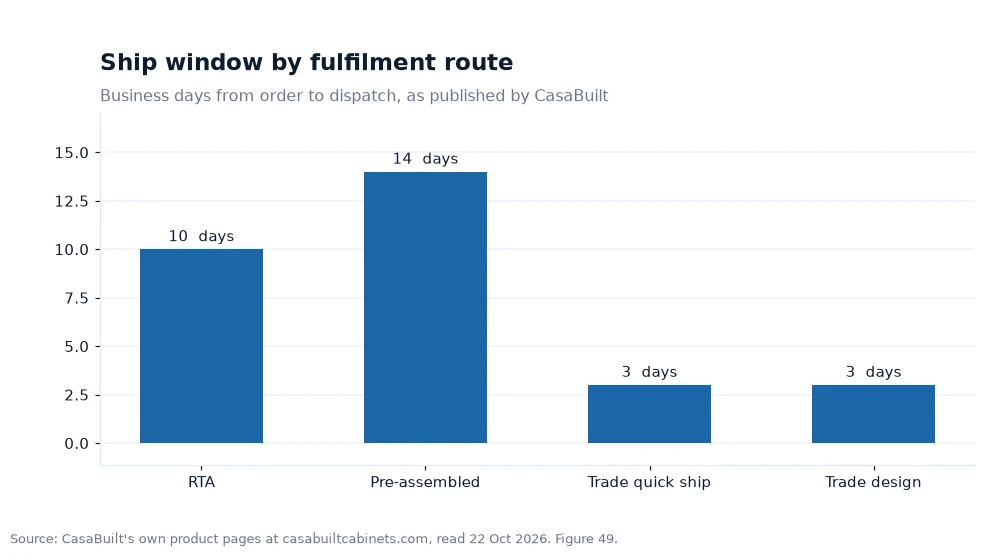
The chart lists four published figures: RTA at 10 days, pre-assembled at 14 days, trade quick ship at 3 days and trade design at 3 days. Compare the cabinet routes first. Pre-assembled is 14 minus 10, or 4 days slower than the RTA slowest case, and 14 minus 3, or 11 days slower than quick ship. RTA at 10 days is 10 minus 3, or 7 days slower than quick ship.
Now place those figures on a 30-day project. For an install on day 30, the pre-assembled order has to be placed by day 30 minus 14, or day 16. The RTA order has to be placed by day 30 minus 10, or day 20. Quick ship allows day 30 minus 3, or day 27. The difference between day 16 and day 27 is 11 days of extra preparation time, which is what the faster route buys.
Add the design step. Trade design takes 3 days, so a design started on day 13 is complete by day 16, which is exactly the pre-assembled deadline. Started on day 17, the design finishes on day 20 and misses the pre-assembled slot but still makes the RTA slot. That is the arithmetic of a remodel schedule: 14 days, 10 days and 3 days are not interchangeable, and the design sits inside all three.
Frequently asked questions
When should cabinets be ordered in a remodel?
Before demolition, once the room has been measured and the layout confirmed. The published windows run from 3 business days for quick ship to within two weeks for pre-assembled, and those are dispatch windows rather than delivery dates. Ordering at least a month before the planned install leaves room for transit, inspection and a replacement part.
Do the cabinets arrive assembled?
It depends on the route. Pre-assembled cabinets arrive joined and squared, so only installation remains. RTA cabinets arrive flat-packed with hardware and printed steps, so assembly happens on site after delivery and outside the published dispatch window. The box, door and hardware specification is the same either way.
Can the design service shorten the schedule?
It can remove the design bottleneck but not the production window. CasaBuilt offers a free 3D kitchen design in 24-48 hours, and the trade design service in less than 72 hours. Both fit inside the 10-day and 14-day cabinet windows, so design is rarely what delays a kitchen; missing measurements usually are.
Put the order date on the calendar
Choose the route, subtract its published window from the install date, then subtract the sample and measuring time from that. Write the resulting order date on the same calendar as the electrician and the countertop template. If the date has already passed, change the route rather than the install date, because the cabinet window is the one part of the schedule the buyer actually controls.
Figures quoted here come from the manufacturer's own website, read 22 Oct 2026[1].